
Sometimes One Event Changes Everything
The Israeli strike on Doha was not just a military operation — it was a political earthquake. Nearly ten installations were destroyed, and suddenly the whole Islamic world woke up. For decades, their security was scattered, their solidarity only in speeches. But this single attack forced OIC (Organisation of Islamic Cooperation) countries to look at themselves in the mirror.
And when this was not enough, India’s Operation Sindhur — striking Pakistan after the Pahalgam terror attack — added fuel to the fire. West Asia and South Asia merged into one theatre of uncertainty. Two wars, two geographies, one storyline.
Riyadh–Islamabad Pact: A Nuclear Shadow
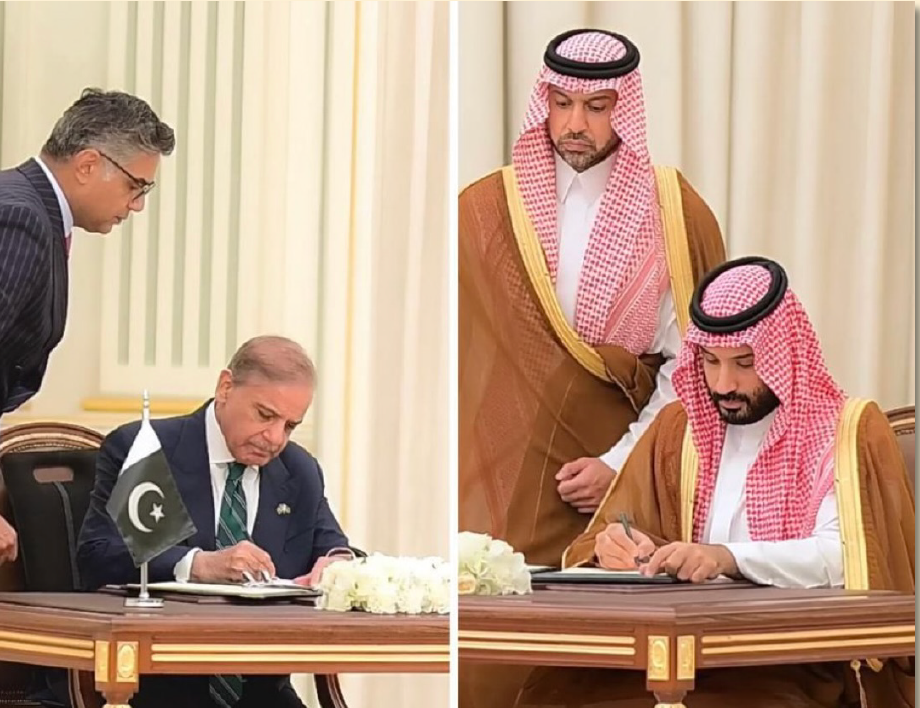
Saudi Arabia and Pakistan have now signed a defence pact that changes the rules of the game.
Any attack on one will be treated as an attack on both.
More importantly, it carries the unspoken code:
Pakistan’s nuclear shield is now Saudi Arabia’s insurance.
This changes the chessboard:
- Pakistan’s lifeline – bankrupt economy suddenly gets Saudi oxygen.
- Saudi’s insurance – no need to build nukes; they are one handshake away.
- Signal to the world – Gulf is turning inward, not toward Washington.
This is not just a pact; it’s a power shift.
Islamic Solidarity: From Words to Weapons
The attack on Qatar exposed the naked truth: Islamic countries are vulnerable, divided, and dependent.
Now, many are tempted by Pakistan’s nuclear umbrella. The slogan has shifted — no longer “America will save us,” but “we will save ourselves.”
But solidarity is never simple:
- Some will stand with Riyadh and Islamabad.
- Others will hesitate, fearing ties with the U.S., Europe, and even Israel.
Brotherhood is real, but business is also real.
America: From Protector to Bystander
For years, America promised Gulf security. But promises without delivery are like empty vessels.
Gulf capitals no longer trust Washington’s handshake. They believe U.S. priorities have shifted — to Russia, China, Indo-Pacific, even domestic politics.
Now Washington faces a choice:
- Tighten alliances with Israel and India, or
- Try to reinsert itself into Gulf defence.
Either way, the perception is clear: America has lost grip on the Gulf.
Pakistan: Beggar State, Nuclear Broker
Islamabad was known for its begging bowl. But with this pact, Pakistan is suddenly wearing the crown of nuclear broker for the Islamic world.
- Saudi cash will keep its economy breathing.
- Its military will gain stature.
- But risks remain — Gulf wars can drain Pakistan’s fragile system.
Saudi patronage can turn autonomy into servitude. Yet, for now, Pakistan has scored a rare victory: from beggar to broker.
Saudi Arabia: Oil Money, Nuclear Muscle
Riyadh is no longer just about oil barrels. First, it shifted to solar energy. Now, it is shifting to nuclear partnerships.
The deal with Pakistan is more than business. It’s about future power. It’s about telling the world:
Saudi Arabia is not just a bank, it is also a barrack.
The gamble is clear: lean on Pakistan for defence, but don’t break with the West. Hedge bets, keep both sides in hand.
India’s Tightrope After Operation Sindhur
For New Delhi, the Saudi–Pakistan pact is a new strategic headache.
If Pakistan-based terrorists strike again and India retaliates, will Riyadh side with Islamabad? That is the million-dollar question.
India must now:
- Deepen defence diplomacy with Riyadh and Abu Dhabi.
- Expand energy and maritime ties beyond the Gulf.
- Prepare for indirect Saudi involvement in any India–Pakistan clash.
Energy, expats, and investments bind India with Saudi Arabia. But terror and retaliation bind India with Pakistan. Balancing both will test India’s diplomacy like never before.
The Larger Shift: Multipolar Security
The old order is breaking.
- America’s shadow is fading.
- Islamic countries are talking about their own shield.
- Pakistan is rising from debtor to defender.
- Saudi is buying security, not just selling oil.
- India is caught in the middle, juggling energy needs with security concerns.
The Hard Truth
- Pakistan: Saudi cash is survival.
- Saudi Arabia: Pakistan’s nukes are insurance.
- America: The Gulf no longer listens.
- India: Diplomacy must be sharper than missiles.
One attack, fifty-seven countries — geopolitics is rewritten.
The new reality is simple: in this part of the world, blood is thicker than water, and sometimes thicker than treaties.
The Doha blast has not just shaken buildings; it has redrawn the world map.
- Saudi buys Pakistan’s nukes.
- America loses its grip.
- India walks a diplomatic minefield.
Verdict: One strike has turned the Islamic bloc into a nuclear shadow, and the balance of power will never be the same again.
— SCOOP
Leave a Reply