
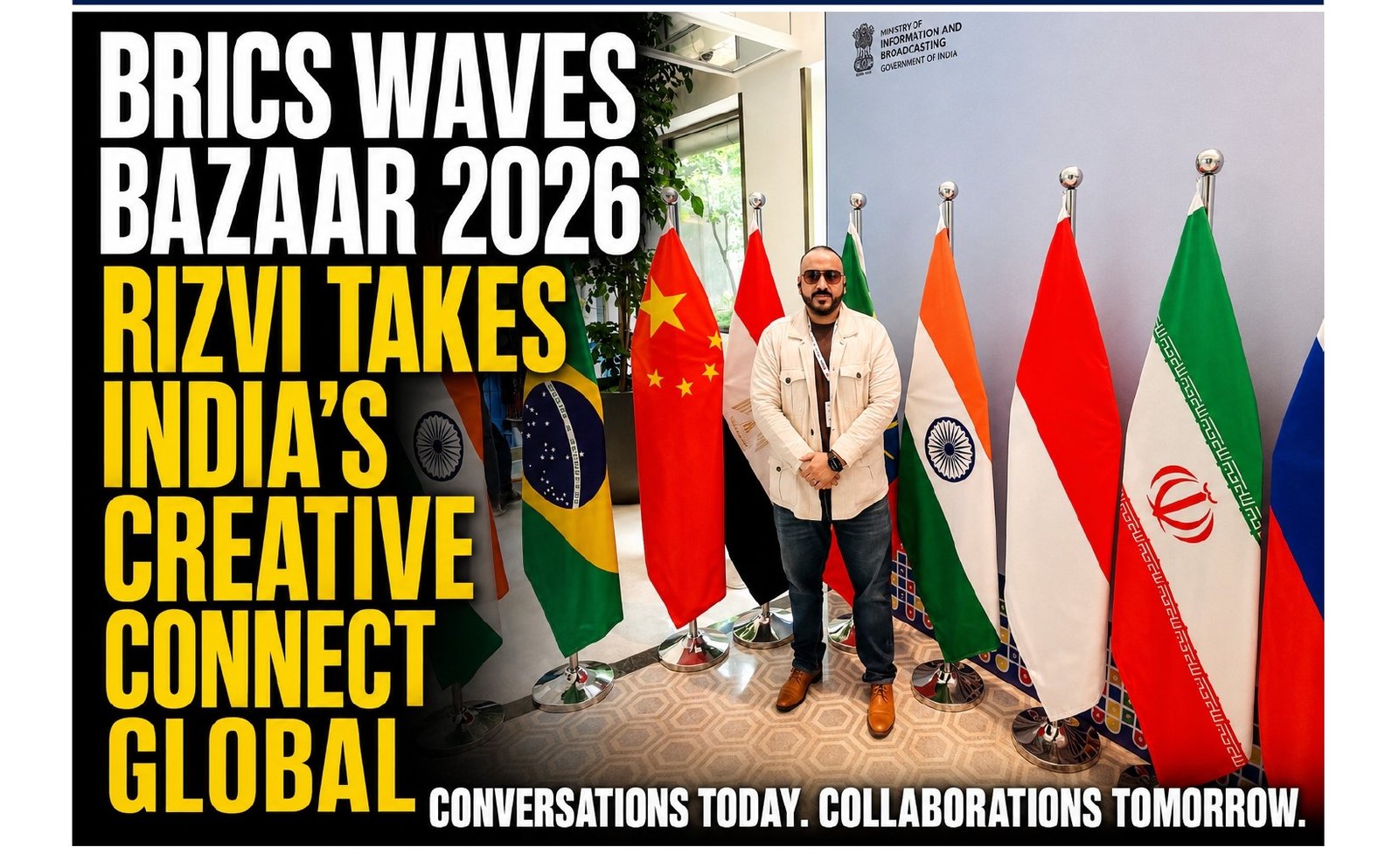
As India Pushes Creative Diplomacy, Sayed Ali Akbar Sultan Ahmed Rizvi Emerges as a Connector Across Borders
By C. SUBRAHMANYAM
It is just after sunrise at Nariman Point. Inside the Trident Hotel, conversations begin long before the formal sessions. Delegates exchange business cards over coffee. Producers discuss co production opportunities with investors. Digital creators compare notes with technology entrepreneurs. Policymakers move between meeting rooms where the next discussion is not about geopolitics or trade, but about cinema, streaming platforms, gaming, music, artificial intelligence and the business of storytelling.
Welcome to BRICS WAVES Bazaar 2026, where India is attempting something bigger than hosting another international conference. It is making a calculated pitch to position the country’s creative economy as an instrument of diplomacy, commerce and global influence.
Among those navigating these corridors with purpose is Sayed Ali Akbar Sultan Ahmed Rizvi of SULTAN PRODUCTIONS whose participation reflects a larger shift taking place within India’s media landscape. In an event built around conversations, partnerships and collaboration, Rizvi represents a growing class of Indian media professionals seeking to build relationships that extend beyond national borders.
Organised by the National Film Development Corporation under the Ministry of Information and Broadcasting during India’s BRICS Chairship, the two day marketplace has brought together more than 500 delegates from 21 BRICS member and partner countries. Unlike a film festival where the spotlight remains on premieres and awards, the Bazaar is designed as a marketplace where ideas are expected to become investments and discussions are expected to become partnerships.
The timing is significant. As global media consumption undergoes a dramatic transformation, countries are increasingly recognising that influence is no longer exercised only through diplomacy or trade agreements. Films, documentaries, streaming content, digital platforms and gaming ecosystems have become powerful vehicles of soft power. India wants a larger share of that influence.
That ambition was evident in the inaugural session attended by Maharashtra Minister Ashish Shelar, Information and Broadcasting Secretary Chanchal Kumar, filmmaker Ashutosh Gowariker and NFDC Managing Director Prakash Magdum. Their message was clear. India intends to move from being one of the world’s largest content producers to becoming a global hub for creative collaboration.
It is within this larger narrative that Rizvi’s participation assumes significance.
Throughout the networking sessions, he interacted with filmmakers, content creators, broadcasters, policymakers and industry leaders from across the BRICS nations, exploring opportunities for future collaboration. His engagement reflected the core philosophy behind the Bazaar that meaningful partnerships begin with direct conversations.
In a message shared after the opening day, Rizvi described the event as an opportunity to represent, connect and explore new possibilities through cinema, media and storytelling. His emphasis on collaboration echoed the central objective of the Bazaar, which seeks to ensure that stories originating in BRICS nations find audiences across the BRICS world.
That objective may sound aspirational, but it is rooted in changing market realities.
The global entertainment industry is expanding rapidly beyond its traditional centres. Streaming platforms have opened new markets. Regional language content is attracting international audiences. Artificial intelligence is reshaping production workflows. Animation, visual effects and gaming are emerging as billion dollar industries. Countries that build collaborative ecosystems today are likely to define the entertainment economy of tomorrow.
Recognising this shift, BRICS WAVES Bazaar has placed equal emphasis on content financing, co production, intellectual property, ethical artificial intelligence, women led entrepreneurship and digital innovation. The Creators Hub, business matchmaking sessions and curated meetings underline that this is as much about commerce as it is about culture.
For participants such as Rizvi, the event provides access to decision makers from multiple countries under one roof. In an increasingly interconnected media ecosystem, such engagement can open doors to collaborative productions, cross border distribution and knowledge exchange.
Yet the bigger story lies beyond the conference halls.
India’s creative economy has long been powered by talent. The challenge has been converting that talent into sustained global partnerships. BRICS WAVES Bazaar represents an attempt to bridge that gap by bringing governments, investors, creators and technology companies onto a common platform.
Whether the initiative delivers lasting outcomes will become evident only in the months ahead. Conferences generate headlines. Partnerships generate industries.
For now, however, the conversations unfolding at Mumbai’s waterfront offer a glimpse of a changing world where creative collaboration is becoming an important pillar of international engagement. And professionals like Sayed Ali Akbar Sultan Ahmed Rizvi are among those helping to translate that vision into practical networks built on dialogue, trust and shared opportunity.
My Shot
BRICS WAVES Bazaar 2026 is not merely another gathering on the international conference calendar. It is India’s attempt to redefine cultural diplomacy for the digital age. As governments seek new avenues of engagement beyond conventional diplomacy, creators, entrepreneurs and media professionals are becoming important ambassadors of that vision. The real success of the Bazaar will be measured not by speeches delivered or photographs taken, but by the partnerships that endure long after the conference concludes.
Leave a Reply